

It’s amazing what meeting new people can spark in our thinking. Recently I met a group of folks who are “into” Russian literature. I put quotes around the word “into” because it’s unusual, but also unlikely that being into Russian literature means going all the way down the rabbit hole and swimming in the well of the Russian Soul. Whatever that means. But I digress.
Being into Russian Literature in the United States means knowing who Dostoevsky was and secretly admiring the person who says they read Crime and Punishment and that it became their favorite book. Or perhaps being into Russian Literature means reading Anna Karenina because Oprah recommended it. Perhaps it means consuming Tolstoy and blinchiki in some rainy café in New York. Or drinking tea and nibbling ponchiki while reading Turgenev and thinking about Nihilism.
These are all well and good, and generally, unusual practices.
But being into Russian Literature might also mean reading Bulgakov or Gogol or maybe even understanding that Pushkin is much more highly regarded than almost any classic author in Russia, primarily because of his poetry. Americans, as a rule, don’t have any idea who Pushkin was or why his poems and short stories are remarkable and beloved by many native Russian speakers. Being into Russian Literature might include a survey of Silver Age poets and imagining what life might have been like, surrounded by poets like Blok, Mandelshtam, Tsvetayeva, and one of my personal favorites, Anna Akhmatova.
But, yet again, I digress.
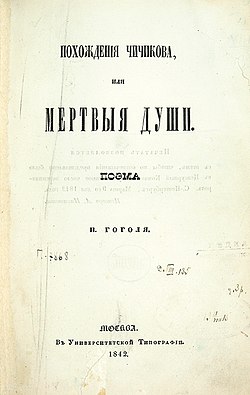
As a result of my recent conversations with folks who are into Russian Literature, I’ve decided to pick up Nikolai Vasilyevich Gogol’s book Dead Souls. I recall discussing this book in undergrad and maybe I Cliffs-noted it.
I don’t recall, actually. I admit now, somewhat abashedly, that I skimmed over many books while in college that are considered groundbreaking and foundational to modern thinking. (Poetry was a different story. I read as much as I could.)
So, now that I am a grown up, I sent off to Amazon and ordered the Richard Pevear and Larissa Volokhonsky translation of Dead Souls. (*Note: Dead Souls has been translated into English at least eleven different times. Constance Garnett’s version is typically the most disseminated version. More on translation later.) Dead Souls is considered rather poetic, so what better way to reacquaint myself with the classics?
I also ordered the Russian language copy. I’m looking forward to diving into this reading / translation / critical assessment project. Why? Because I can. But also, in speaking with a person whose opinion I trust, I heard “Dead Souls is funny and sad, but extremely relevant to our modern times.”
This was enough for me to jump “into” the book and back into Russian Literature.
 The Bear View
Leave a comment