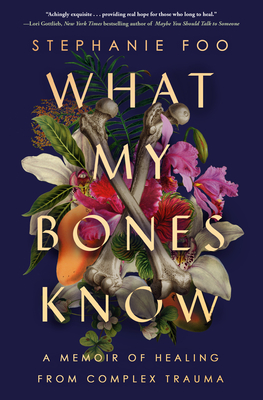
The Value of PTSD

“I was made for this moment. [Dr. Hom] would tell me that PTSD is only a mental illness in times of peace. The whole point of PTSD is to prepare you for being on the verge of death at any moment.”

–Stephanie Foo, What My Bones Know: A Memoir of Healing from Complex Trauma

I confess, this memoir was horrible and enlightening at the same time. I started reading the book and then found I couldn’t keep going (trigger warning — if you have cPTSD you may also have issues). So I ended up getting a copy of the Audible version. It took me awhile to listen to the book as some parts were too intense.

Ms. Foo is a vivid storyteller, and in the Audible version, you can hear her family come through in the phrases she uses. I felt like I met many of her family members as she explored her past.

I appreciated the experimentation and review of all things related to healing complex trauma. This is a down to earth, real human approach to healing. Or at least to living a better life.

Notwithstanding the intensity of the abuse described in the book, quite a bit of it was enlightening, especially some of the therapeutic observations and the way cPTSD survivors deal with traumatic situations later in life (like COVID lockdowns, etc.).

I would knock the score down from 5 stars just a bit because the author’s political bias came out a few times. It was expected, considering where she grew up, and not too overwhelming, so I was able to keep reading/listening.

Recommended. Especially if you’re working through cPTSD or if you love someone with the diagnosis or who is likely to have cPTSD, based on their upbringing.


Rating: 5 out of 5.

Some Thoughts on Trauma and Thinking Patterns

I’m slowly making my way through Dr. Woodhouse’s You’re Not Broken (link)because there’s a lot to process. Reading a book like this can be overwhelming, and she points that out. Sometimes we need professional help to sort through all the thinking and trauma loops we’ve collected and included in our daily lives.

This morning’s reading was enlightening. Dr. Woodhouse lists some common traumatic thinking patterns, and I will share them here with you. If you recognize yourself in this list, it might be good to read this book/seek healing assistance/discuss these ideas with a professional:

  • Mind-reading (guessing, second guessing, guessing again what others are thinking)
  • Shoulds (I should be working harder)
  • Self-Sabotaging (what’s the point in trying, I might as well give up)
  • Destructive decision-making (I’m going to give up)
  • Worry and rumination (running over and over the same thing in your mind)
  • Black-and-white thinking (I’m right, you’re wrong — not being able to find a measured middle-ground)
  • Catastrophising (I’m definitely going to lose my job because I made that little mistake)

Now, I’m sharing these because it might be helpful to connect the patterns with your own thinking. It doesn’t stop there. This book has exercises to help you work through the patterns and release habits.

One particular tool that I intend to try soon (really, I do!) is to journal through some of the reactions, thoughts, and triggers that may be connecting with self destructive behaviour. Dr. Woodhouse writes that “[t]his tool is about observing your daily life, yourself, your reactions, physical sensations, feelings, thoughts and behaviour.”

It doesn’t have to be perfect, but it could be helpful as a starting point for those working through trauma and the after effects of trauma.

Let me repeat that. It doesn’t have to be perfect to be helpful.

And one thing I’m pretty sure about is that journaling in and of itself won’t be harmful. It may bring up some painful memories, though. It may be uncomfortable.

For me, though, lately the discomfort of working through trauma is less than the discomfort of being trapped in a trauma loop. A catch phrase that I’ve heard in 12 step groups is “stinkin’ thinkin'”. Stinkin thinkin is not a pretty place. It’s not a happy place. It might be comfortable, because it’s familiar. Suffering might be familiar, but that doesn’t mean we need to marinate in it.


Book Review – Man’s Search for Meaning

Man’s Search for Meaning on Amazon

This was a thought-provoking book. The first half was quite compelling. It describes the author’s experience in concentration camps during WWII. There were some fascinating insights into how people cope with abnormal times.

My reason for a four star rating is that I am perhaps a little too dense to understand parts of the second half, where the author discusses logotherapy and applying it.

I would recommend this book to anyone seeking some understanding of suffering and how humans need to have a purpose. It is also a good read for those who are coping with PTSD. I will probably read this book again, which is atypical for me. Quite often I am a “one and done” reader, but here, it seems there are enough insights and observations worth reviewing again.

Rating: 4 out of 5.


Choose

“Everything can be taken from a man but one thing: the last of the human freedoms—to choose one’s attitude in any given set of circumstances, to choose one’s own way.”

― Viktor E. Frankl, Man’s Search for Meaning

Website Powered by WordPress.com.

Up ↑