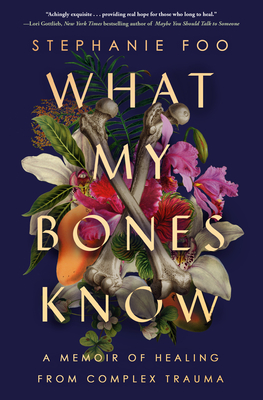
The Value of PTSD

“I was made for this moment. [Dr. Hom] would tell me that PTSD is only a mental illness in times of peace. The whole point of PTSD is to prepare you for being on the verge of death at any moment.”

–Stephanie Foo, What My Bones Know: A Memoir of Healing from Complex Trauma

I confess, this memoir was horrible and enlightening at the same time. I started reading the book and then found I couldn’t keep going (trigger warning — if you have cPTSD you may also have issues). So I ended up getting a copy of the Audible version. It took me awhile to listen to the book as some parts were too intense.

Ms. Foo is a vivid storyteller, and in the Audible version, you can hear her family come through in the phrases she uses. I felt like I met many of her family members as she explored her past.

I appreciated the experimentation and review of all things related to healing complex trauma. This is a down to earth, real human approach to healing. Or at least to living a better life.

Notwithstanding the intensity of the abuse described in the book, quite a bit of it was enlightening, especially some of the therapeutic observations and the way cPTSD survivors deal with traumatic situations later in life (like COVID lockdowns, etc.).

I would knock the score down from 5 stars just a bit because the author’s political bias came out a few times. It was expected, considering where she grew up, and not too overwhelming, so I was able to keep reading/listening.

Recommended. Especially if you’re working through cPTSD or if you love someone with the diagnosis or who is likely to have cPTSD, based on their upbringing.


Rating: 5 out of 5.

Some Thoughts on Trauma and Thinking Patterns

I’m slowly making my way through Dr. Woodhouse’s You’re Not Broken (link)because there’s a lot to process. Reading a book like this can be overwhelming, and she points that out. Sometimes we need professional help to sort through all the thinking and trauma loops we’ve collected and included in our daily lives.

This morning’s reading was enlightening. Dr. Woodhouse lists some common traumatic thinking patterns, and I will share them here with you. If you recognize yourself in this list, it might be good to read this book/seek healing assistance/discuss these ideas with a professional:

  • Mind-reading (guessing, second guessing, guessing again what others are thinking)
  • Shoulds (I should be working harder)
  • Self-Sabotaging (what’s the point in trying, I might as well give up)
  • Destructive decision-making (I’m going to give up)
  • Worry and rumination (running over and over the same thing in your mind)
  • Black-and-white thinking (I’m right, you’re wrong — not being able to find a measured middle-ground)
  • Catastrophising (I’m definitely going to lose my job because I made that little mistake)

Now, I’m sharing these because it might be helpful to connect the patterns with your own thinking. It doesn’t stop there. This book has exercises to help you work through the patterns and release habits.

One particular tool that I intend to try soon (really, I do!) is to journal through some of the reactions, thoughts, and triggers that may be connecting with self destructive behaviour. Dr. Woodhouse writes that “[t]his tool is about observing your daily life, yourself, your reactions, physical sensations, feelings, thoughts and behaviour.”

It doesn’t have to be perfect, but it could be helpful as a starting point for those working through trauma and the after effects of trauma.

Let me repeat that. It doesn’t have to be perfect to be helpful.

And one thing I’m pretty sure about is that journaling in and of itself won’t be harmful. It may bring up some painful memories, though. It may be uncomfortable.

For me, though, lately the discomfort of working through trauma is less than the discomfort of being trapped in a trauma loop. A catch phrase that I’ve heard in 12 step groups is “stinkin’ thinkin'”. Stinkin thinkin is not a pretty place. It’s not a happy place. It might be comfortable, because it’s familiar. Suffering might be familiar, but that doesn’t mean we need to marinate in it.


From You’re Not Broken, by Dr. Sarah Woodhouse

I’m reading Dr. Woodhouse’s book, You’re not Broken: Break Free from Trauma and Reclaim Your Life, which was recommended to me–I’m not sure from where, but it sounded like something I needed to read.

This morning a quote struck me as important to healing and so I will share it with you:

Many people who have trauma have low self esteem. We cannot afford to be around people who lower it further. We cannot afford to be around people who drag us back and pull us down. We need to find ways to build our confidence and sense of self. Taking part in relationships that reflect the future we want will help us do this.

– Dr. Sarah Woodhouse, You’re Not Broken

It might come across as ‘get rid of all your friends’ but actually, I think it is a good reminder of that old saying that you are the sum of your five closest friends. Are they what you want to become? Are they willing to change with you, if you’re working on your own well being?

Food for thought on this rainy Monday.


The Body Papers by Grace Talusan

An excerpt from the Goodreads description: Born in the Philippines, young Grace Talusan moves with her family to a New England suburb in the 1970s. At school, she confronts racism as one of the few kids with a brown face. At home, the confusion is worse: her grandfather’s nightly visits to her room leave her hurt and terrified, and she learns to build a protective wall of silence that maps onto the larger silence practiced by her Catholic Filipino family.

It’s rare that I read a memoir so quickly, and rare that I’m emotionally affected by the narrator’s life. The Body Papers by Grace Talusan hit both.

The pacing was brisk, the images vivid. Grace Talusan connects us with her story and what it was like to grow up in one of two Filipino families in a small town in Massachusetts. We travel back to the Philippines with Grace when she’s an adult and see the country through her eyes. This book was better and more vivid than any movie.

She also shares her childhood trauma with us in a way that is relatable and poignant.

Recommended. 5/5 stars.

Rating: 5 out of 5.

Related Posts

Gratitude 2020 – Countdown to Thanksgiving

I took a couple days off from posting. Not from writing down my gratitude lists, but from declaring them publicly. I needed to rest. So rest I did.

I’m not usually the type of person to give myself permission to rest. I’ve been feirly busy since I was a teen in high school with a couple of jobs, extracrricular activity, you name it. Then later, full time schooling, jobs, activities.

Starting a family added to the busy. Still I managed to go to work, have kids, get a secondary degree. I never felt like I could rest, even when I wanted to.

Not too long ago, I had a job that ratcheted up the imbalance of obligation and work to never before seen heights. In part, the imbalance was set by trauma. More than six catastrophic events, at least that’s what the post-critical-incident debriefing therapist told me, had occurred in approximately six months.

I could feel every one of those events, ringing in my bones like the thrum of a singing bowl. Or the scrape of nails on blackboards. If you know what a blackboard is, you’re of a certain age. Mature, like me.

After leaving the super catastrophic situation I was in, I found I no longer wanted to burn for work, for obligation, for anything that wasn’t in line with a higher vision for me. And so I took a good hard look at what mattered.

Then the pandemic made me take many more moments to consider what matters.

The bottom line is this: rest is essential.

Photo by Sebastian Voortman on Pexels.com

We can work hard and drive at a target. That’s commendable. But we may burn out. Burn up. Land face down in the dirt. And it’s hard to get up when you’ve turned yourself into a twitching, irritable individual who trusts no one.

But taking rest when needed is not a bad thing. It’s actually a very good thing. Rest. If that means sleeping, or lounging, or just putting a few strong goals aside until your energy is up again.

It’s like running and walking. If you alternate, you last longer. You can go miles with intervals, when you may not be able to go very far at all on a sprint.

Meanwhile, my gratitude is for those who have helped me learn how to, remember how to, and feel ok with taking time to rest.

I’m grateful for the lesson. Thankful that I “got it” after all these years.

It’s never too late to learn something new.


Website Powered by WordPress.com.

Up ↑